Why does a sway bar need to be verified via fixture in industrial production?
- Share
- Issue Time
- Dec 29,2025
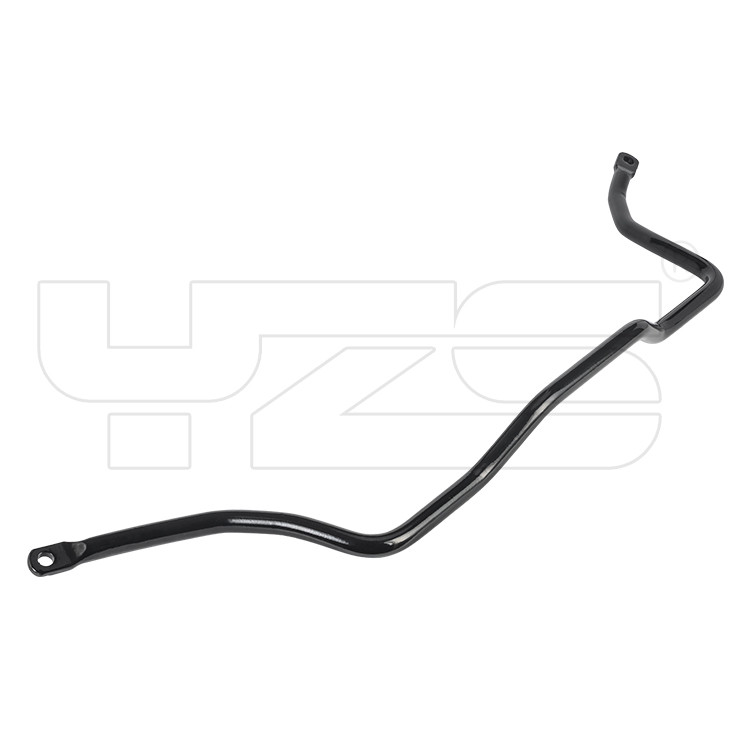
Why does a sway bar need to be verified via fixture in industrial production?
Sway bar (in industrial contexts, typically referring to a stabilizer bar or anti-roll bar used in vehicle suspension systems) requires verification via fixture during production for several key reasons related to quality control, safety, performance, and manufacturing consistency.
Here’s a breakdown of the explanation:
1. Precision and Dimensional Accuracy
Why: A sway bar must meet exact geometric specifications (length, bend angles, arm orientation, etc.) to fit correctly into the vehicle’s suspension assembly.
Fixture Role: A verification fixture (often a custom jig or gauge) physically checks if the part matches the designed CAD model. It ensures that critical dimensions are within tight tolerances.
2. Functional Performance Validation
Why: The sway bar’s primary function is to control body roll during cornering. Its shape and stiffness directly affect vehicle handling and safety.
Fixture Role: Fixtures can simulate the installed position and apply predefined loads to check for deflection, twist, or stress points. This ensures the bar will perform as intended in real-world conditions.
3. Interchangeability and Assembly Compatibility
Why: In mass production (e.g., automotive manufacturing), parts must be interchangeable. A non-conforming sway bar could cause assembly line stoppages or require force-fitting, leading to premature failure.
Fixture Role: Verification fixtures act as a "go/no-go" gauge to quickly identify parts that won’t fit in the vehicle’s subframe or attachment points.
4. Detection of Manufacturing Variability
Why: Sway bars are often forged, bent, or heat-treated—processes that can introduce variations (e.g., springback after bending, distortion during quenching).
Fixture Role: Fixtures provide a rapid, repeatable way to check for these inconsistencies before the part moves to the next production stage.
5. Safety and Reliability Assurance
Why: A failed sway bar (e.g., due to incorrect material, poor welding, or fatigue from improper geometry) can compromise vehicle stability and cause accidents.
Fixture Role: Fixture-based verification catches critical defects early, reducing the risk of field failures and recalls.
6. Cost and Efficiency in Mass Production
Why: Manual measurement of every sway bar with calipers or CMMs (Coordinate Measuring Machines) is time-consuming and expensive.
Fixture Role: Simple, robust fixtures allow quick visual or tactile checks by line operators, enabling 100% inspection if needed without slowing production.
Typical Fixture Design for Sway Bar Verification:
Geometry Check Fixture: Uses hardened pins, bushings, and contour plates to verify hole positions, arm lengths, and bend radii.
Torque/Angle Test Fixture: Applies torque to the bar ends to validate stiffness and twist angle under load.
Welding/Assembly Fixture: Ensures brackets or bushings are correctly positioned before welding or pressing.
Conclusion:
In summary, verification via fixture for sway bars is a critical quality gate in industrial manufacturing. It ensures that each part:
✅ Fits perfectly in the vehicle assembly.
✅ Functions safely under mechanical stress.
✅ Meets design specifications consistently at high production speeds.
✅ Prevents costly defects from reaching customers.
This practice aligns with industry standards (like IATF 16949 in automotive) and supports Lean Manufacturing principles by reducing waste, rework, and variability.