Industrial Manufacturing Process of Sway bar
- Share
- Issue Time
- Mar 6,2026
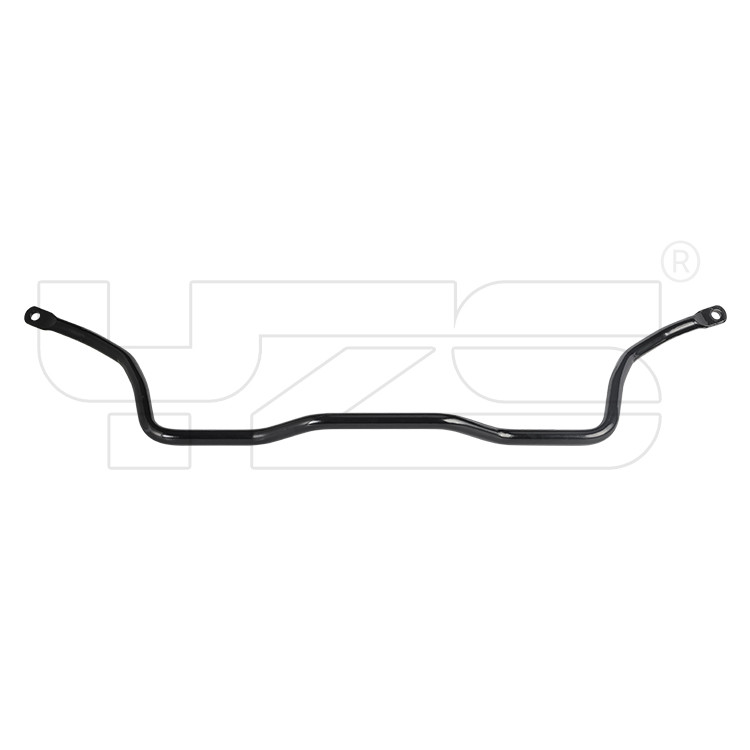
Step 1: Raw Material Selection and Preparation
High-quality quenched and tempered steel is selected as the raw material for the stabilizer bar, which ensures the component has excellent toughness and strength without the need for additional quenching after forming. The raw steel is usually supplied in the form of rods, and the first step is to inspect the chemical composition and mechanical properties of the steel to ensure it meets the design specifications, especially the strength requirements of the torsion spring part (at least 1000MPa) and the formed end part (at least 800MPa).
Step 2: Blanking and End Machining
The raw steel rods are cut into fixed-length blanks using a blanking machine according to the design dimensions of the stabilizer bar. Then, the ends of the blanks are processed on a punch press to form the basic shape of the connecting ends, laying the foundation for subsequent hole punching and assembly.
Step 3: Cold Bending Forming
The blank is bent into the required shape (including the central torsion spring part and two side arms) on a cold bending machine. This step requires high precision to ensure that the bending angle and curvature of each part meet the design requirements, as the shape of the stabilizer bar directly affects its anti-roll performance during vehicle operation. For tubular stabilizer bars, the tube is first manufactured by rolling steel strips and welding them longitudinally, then bent to form the arm structure.
Step 4: Stress Relief Tempering
After cold bending, the stabilizer bar has internal residual stress, which may lead to deformation or fatigue damage during use. Therefore, it is put into a tempering furnace for stress relief tempering, where the temperature is controlled between 150℃ and 250℃, and the tempering time is 20 to 40 minutes. This process can eliminate internal stress, improve the toughness of the material, and ensure the dimensional stability of the stabilizer bar.
Step 5: Cold Sizing and End Forming
The tempered stabilizer bar is subjected to cold sizing on a cold sizing machine to correct any slight deformation caused by tempering and ensure the overall dimensional accuracy. For the end parts, local heating is performed (usually by induction heating), and then hot forming is carried out to form the shaped end parts with through holes, which are then hardened again to meet the strength requirements of at least 800MPa.
Step 6: Surface Treatment and Quality Inspection
Finally, the stabilizer bar is subjected to surface treatment, usually using powder coating to form a protective finish, which improves corrosion resistance and extends service life. After surface treatment, strict quality inspection is carried out, including dimensional measurement, hardness testing, and appearance inspection, to ensure that each stabilizer bar meets the industrial standards and design requirements before leaving the factory.